
The Bill was introduced in the Lok Sabha in December.

Finance Minister Arun Jaitley to discuss state-level issues before finalising GST.
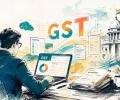
As India marks a decade of the Goods and Services Tax (GST), the focus is shifting towards enhancing efficiency through artificial intelligence, data sharing, and process simplification. The reform, which unified India's indirect tax system, has significantly broadened the tax base and boosted revenues, with future plans including a streamlined two-tier rate structure and continued technological integration to reduce compliance costs and combat evasion.

Central tax authorities detected input tax credit (ITC) fraud worth Rs 74,781.56 crore across 30,162 cases in FY26, more than doubling the number of cases from the previous year, according to the Ministry of Finance.

Opposition-ruled states warn of steep annual losses; Centre assures higher consumption will offset revenue hit.

Economists highlight that resolving domestic policy bottlenecks, particularly through land reforms and improving the ease of doing business, will be critical for Prime Minister Narendra Modi's 'next-generation reforms' and India's economic transformation towards its 'Viksit Bharat' vision for 2047.

Election-related freebies and populist measures are other factors crimping the revenue profile of these states.

'You have to get private investment to somewhere between 35% to 36% of GDP. It is hovering about 30%-31%.'

Any reduction on purifiers would need consensus among state finance ministers.

'Improved law and order and transparent governance have helped change UP's investment image.'

Fino Payments Bank asserts its compliance with GST regulations following the arrest of its MD and CEO, Rishi Gupta, by the Directorate General of GST Intelligence (DGGI). The bank clarifies that the investigation pertains to program managers associated with multiple banks and not the bank's own GST compliance.

Addressing the Lok Sabha on Wednesday, Finance Minister Pranab Mukherjee called for the inclusion of petroleum products in proposed goods and services tax so that sharp domestic price movements can be checked.

During the meeting with Prime Minister Narendra Modi, Vijay raised concerns, including rendering Tamil Thai Vazhthu at the beginning of government events, opposition to Karnataka's proposed Mekedatu dam project, the release of Tamil Nadu fishermen detained by Sri Lanka, and the establishment of a key defence research facility in the state.

The GST Council at its next meeting may consider a reduction in taxes on air and water purifiers as air quality across the country worsens and access to safe drinking water remains uneven.

While Union Finance Minister Nirmala Sitharaman reiterated her stand that the central government was committed to cooperative federalism, finance ministers of non-BJP ruled states such as Punjab and Kerala said she refused to give a categorical assurance that states will be paid compensation on time.
Nearly 96 per cent of new applicants will benefit from this simplified approval route.

The Aam Aadmi Party (AAP) has strongly criticised the Enforcement Directorate (ED) raid and subsequent arrest of Punjab minister Sanjeev Arora, calling it a politically motivated act by the BJP-led central government. AAP leaders allege the BJP is misusing central agencies to suppress opposition voices and destabilise the AAP government in Punjab.

The Centre has proposed exempting life and health insurance policies for individuals from GST, Bihar Deputy Chief Minister and convenor of insurance GoM Samrat Choudhary said on Wednesday. Currently, health and life insurance premium attracts 18 per cent GST.

Victory wrested from regime that only listens when forced, the TMC said on GST exemption on insurance.
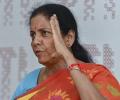
This is not her first stint in North Block or in leading a major economic ministry. She started Prime Minister Narendra Modi's first term as minister of state for finance, was made the commerce minister, and then became the defence minister.

Palanivel Thiaga Rajan was on Thursday relieved of the finance portfolio by Tamil Nadu Chief Minister M K Stalin.

'Ek baar aap GST dekh lo!' - Prime Minister Narendra Modi's gentle nudge to Finance Minister Nirmala Sitharaman in December last year sparked the beginning of a mammoth exercise to overhaul the tangled goods and services tax regime. And the final outcome is a significantly simplified system with lower tax rates and easier compliance for businesses.

The Delhi High Court has asked the central government why it cannot reduce the GST on air purifiers, considering the poor air quality in Delhi. The court's concern is that the current 18% GST makes air purifiers unaffordable for the common man.

The GoM of state ministers on GST rate rationalisation on Thursday accepted the Centre's proposal to move to a two-slab structure of 5 and 18 per cent. Bihar Deputy Chief Minister and convenor of rate rationalisation GoM Samrat Choudhary said the six-member state ministerial panel has also accepted the proposal of removing the 12 and 28 per cent slabs.

The finance ministry on Friday said it has proposed a two-slab GST rate structure to the Group of Ministers (GoM), along with special rates for select items.

'You have seen the retrenchments by big corporates in the IT industry because they are not getting enough offers.' 'MSMEs in the manufacturing sector are really struggling. They do not know what to do. They are not able to predict what will happen tomorrow.'

New lower GST rates kicked in from Monday, resulting in a slashing of prices of as many as 375 items ranging from toothpaste and shampoo to cars and television sets, a move seen as an attempt to boost consumption to cushion an economy facing tariff headwinds. Tax rates of 5, 12, 18, and 28 per cent have been clubbed into two rates of 5 per cent and 18 per cent, resulting in a reduced price of 99 per cent of daily use items.

The conflict may disrupt Budget 2026-2027 projections, squeezing revenues and raising subsidies, prompting fiscal adjustments and potential reforms, echoing lessons from the Covid-era shock, points out A K Bhattacharya.

The Delhi High Court has directed the GST Council to consider lowering or abolishing the goods and services tax on air purifiers, citing worsening air quality in the national capital. The court has asked the council to meet at the earliest, even via video conference if necessary, to address the issue.

These changes certainly bring India's GST a lot closer to what an ideal GST would look like, points out Karan Bhasin.

If TVK MLAs and ministers are perceived as clean, or demonstrably cleaner than their predecessors, the credibility dividend will be enormous. The voter will feel rewarded, points out Ramesh Menon.

Since items in the 12% category account for only about 5% of total GST, the additional boost to consumption may not be significant, points out M Govinda Rao.

Here are the key numbers to watch out for in the Union Budget for 2025-26:
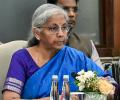
To ensure a glitch-free rollout of the next-generation GST with reduced rates and lesser slabs, Finance Minister Nirmala Sitharaman chaired three separate meetings to assess GSTN's preparedness and the time it would take to implement technological changes required in the software systems.
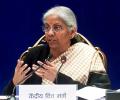
The GST Council on Saturday postponed a decision on cutting tax rate on life and health insurance premiums, officials said. The 55th meeting of the GST Council, chaired by Union Finance Minister Nirmala Sitharaman and comprising state counterparts, decided that some more technicalities needed to be ironed out and tasked the GoM for further deliberations.
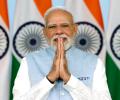
The Congress party has criticized Prime Minister Narendra Modi's handling of GST reforms, calling them inadequate and demanding an apology for the tax imposed on essential items. They argue that the reforms are merely a 'band-aid' solution and that the government should address the states' demand for extended compensation.
Budget has already bombed at the box office and passing it without a revisit will be a mockery of the exercise though any modification may be short lived and perfunctory, observes V Ranganathan.
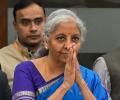
The GST Council on Wednesday approved a two-tier rate structure of 5 and 18 per cent, which will be implemented from September 22.
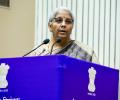
Finance Minister Nirmala Sitharaman on Saturday said the GST rates will come down further and the work on rationalising tax rates and slabs has "almost reached a finale". She said that the revenue neutral rate (RNR) has come down from 15.8 per cent at the time of the launch of GST on July 1, 2017, to 11.4 per cent in 2023.

Three laws passed in Parliament could boost central revenues, reshape GST cess flows, shift MGNREGA costs to states and create new budget headroom ahead of the 2026-2027 Union Budget, points out A K Bhattacharya.
